Bishal first mentioned a two-day trail run through remote Southern Lalitpur. It is not a place that appears on the usual hiking or trekking destinations. This leaves Southern Lalitpur and its trails quiet and largely untouched. The region unfolds through isolated villages, lush forests, crystal-clear rivers, and high ridges offering sweeping views of both the Kathmandu Valley and the distant Terai plains.
Bishal shared an extraordinary map outlined in yellow, encompassing the Village Development Committees of Konjyosom, Mahankal and Bagmati. Most of the places marked along the route were unfamiliar to me. Apart from passing through Tikabhairab, Tinpane, and travelling the old highway towards Hetauda via Makwanpur Gadhi, I knew very little about this landscape.
Yet the map felt strangely sacred, almost like an invitation to a pilgrimage through a backyard I never knew existed. The promise of remoteness, old trails, and seldom-visited villages was impossible to resist.
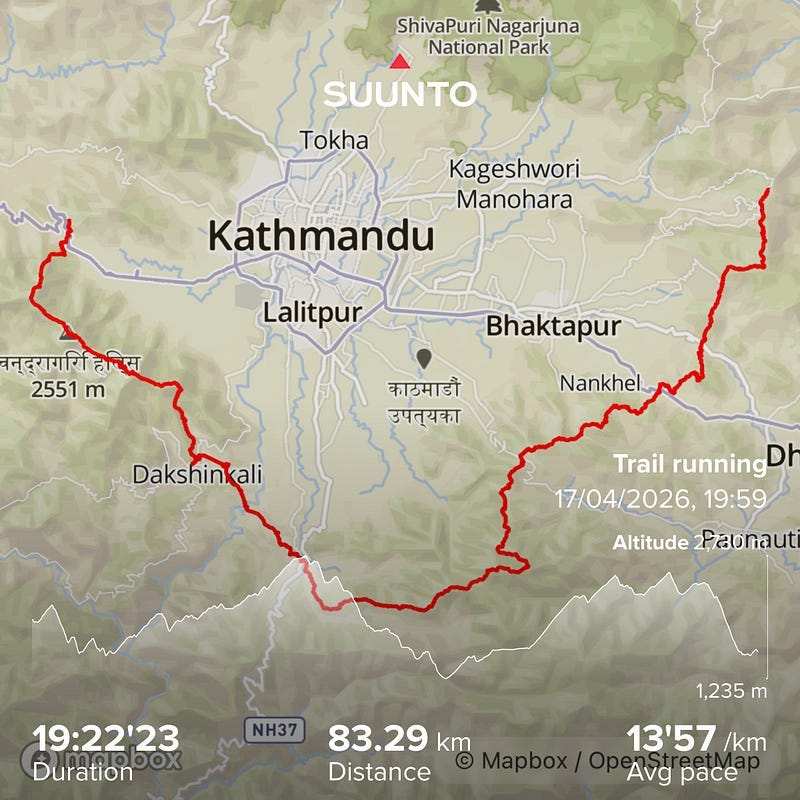
Bishal has been exploring Southern Lalitpur in fragments since 2024 - usually one-day long trail runs. He has been slowly piecing together the trails and settlements. His idea was simple yet ambitious - connect these scattered dots into a single endurance route spanning 80 to 120 kilometres through the far-flung villages and layered hills of the region. The run would eventually become the Endurance Run de la Southern Lalitpur. Bishal envisioned an endurance trail race. In a way this felt like participating in the early chapters of a story that might one day become a sought after enduro trail. It was a privilege to help trace those lines across the hills of Southern Lalitpur.
What struck me most was the remoteness of the region despite its surprising proximity to Kathmandu. Bishal first spoke about the run during an exploratory run around Banepa. Initially we planned it for the Tihar holidays. Later it was scheduled immediately after Bhai Tika, on the very day I was expected to return to work. Though my response was immediate ‘yes’, I didn’t share this with my family until I had already left. I sent video messages to my family from Dalchoki.
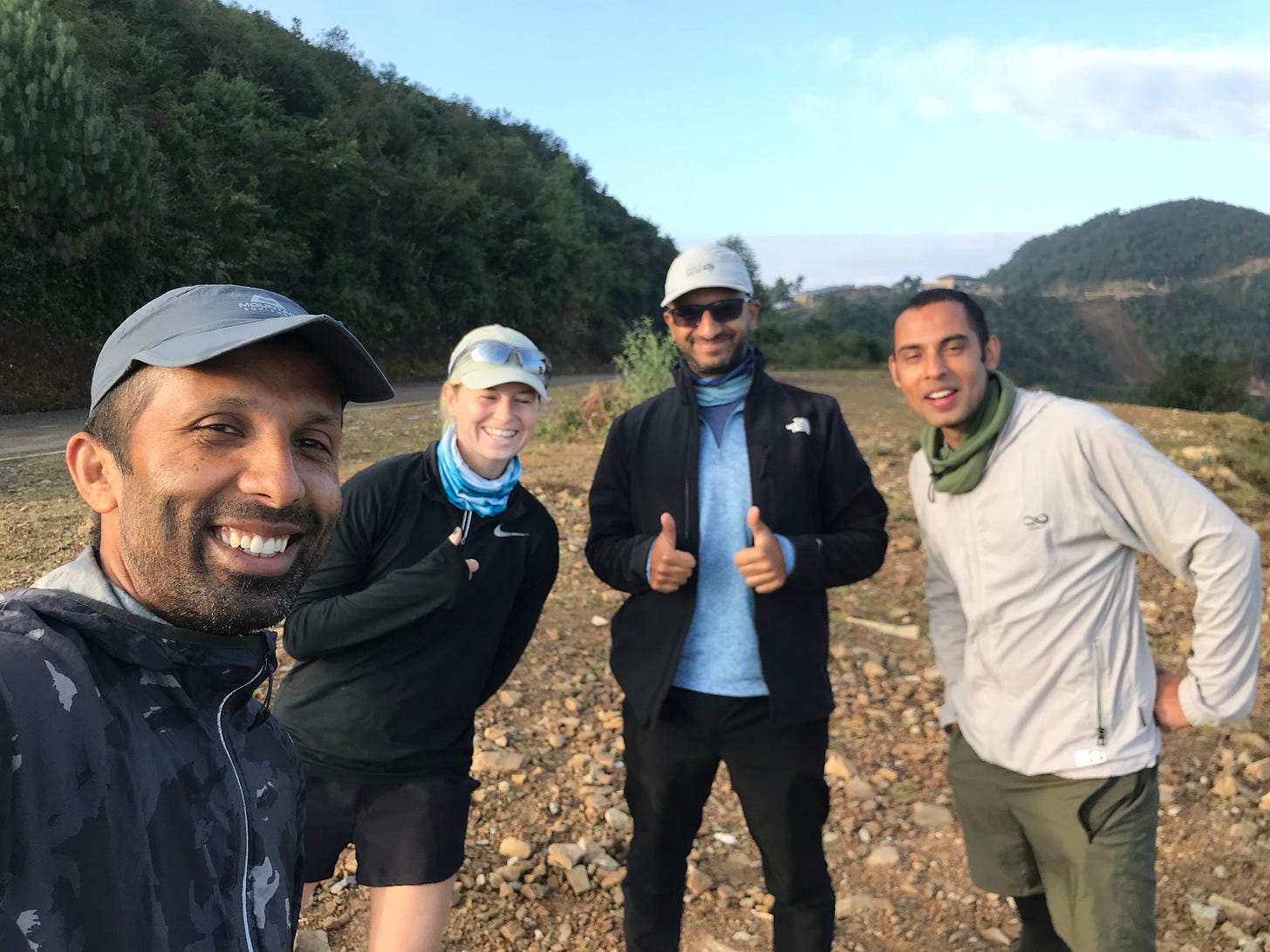
What made the experience even more special was the group itself: Bishal, Alex, Bishnu and me. We shared a love for long trails and uncertainty, but more importantly, there was trust and empathy. Everyone brought different strengths and perspectives, yet there was a quiet respect for one another throughout the journey. That spirit carried us through many moments over the next two days.
The route planned by Bishal included Dalchoki as trail head, Sankhu via Thosne Khola, Gotikhel via Bukhel, Kaleshwor Mahadev Hill Top via Siswan, Barkithum, Baluwadanda, Syal Bhanjayng, Magar Gaun, Bajhagaun, and Gimdi. Day two started in Gimdi, passing through Asrang where we parted ways. I had to be home early in the evening the same day. Bishnu too had some other plans that evening. I and Bishnu continued to Pyutar, Gadhi Bhanjyang, Khani Khola and Baguwa. Bishal and Alex embarked to Majhkhanda Danda north from Asrang; and route back to Dalchoki running through Kalon to Chapeli, Bhatte Danda and Tinpane via Kanti Highway.
We started with an early morning drive to Dalchoki on Thursday, 12th November. It started before we even realised we were in. Alex shared this quirky surreal feeling - we were there and actually doing it for real!
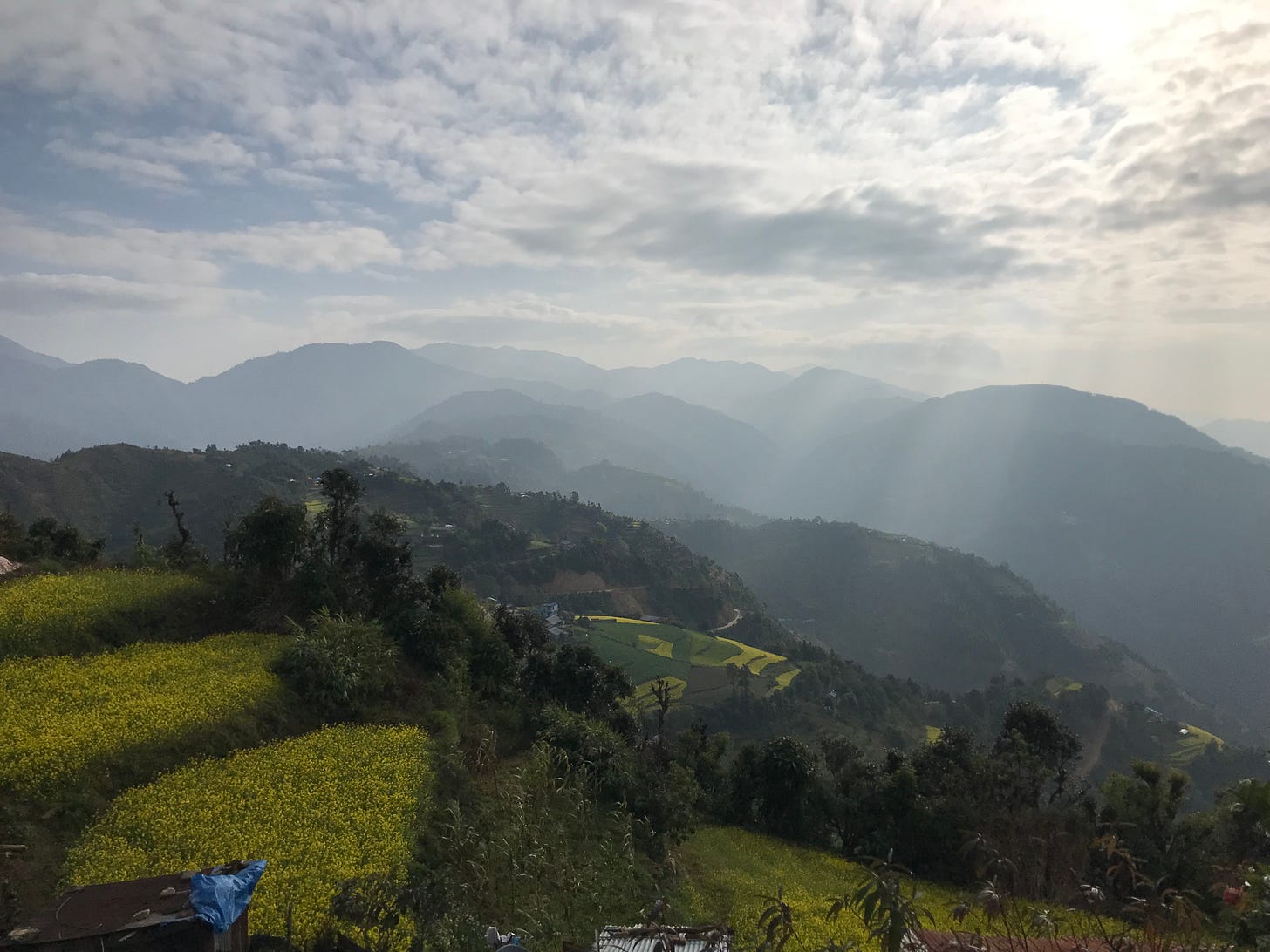
After a nice, warm breakfast and some strong spiced black tea, we found ourselves surrounded by layers of hills with that special blue-white haze. The shafts of early morning sunlight pierced through the clouds. Nearby mustard fields glowed in warm yellow beneath that magical early morning. It made me feel as though I were in a dream. Almost trying to wake up to a breath-taking and lovely gift that was waiting to be discovered.
We ran down to Thosne Khola. We chose to ditch the bridge that crossed the river. I ran through the water with my shoes on, while the others took theirs off.
The route that followed was a beautiful single trail towards Sankhu. It is one of the most beautiful trails I have ever been on. As we joined a wider trail, a dirt road, Bishal called upon an acquaintance at a village home. Out came a woman with remarkably kind eyes. After a few exchanges, she offered us Mohi. We relished the thick and sour drink made from buffalo milk. The tangy sourness almost felt like Raksi, lifting our spirits instantly. Before we left, she filled a bottle for us to carry on the trail. I tried offering some money in return, but she gently refused. Instead she added Sel Rotis and fruits.
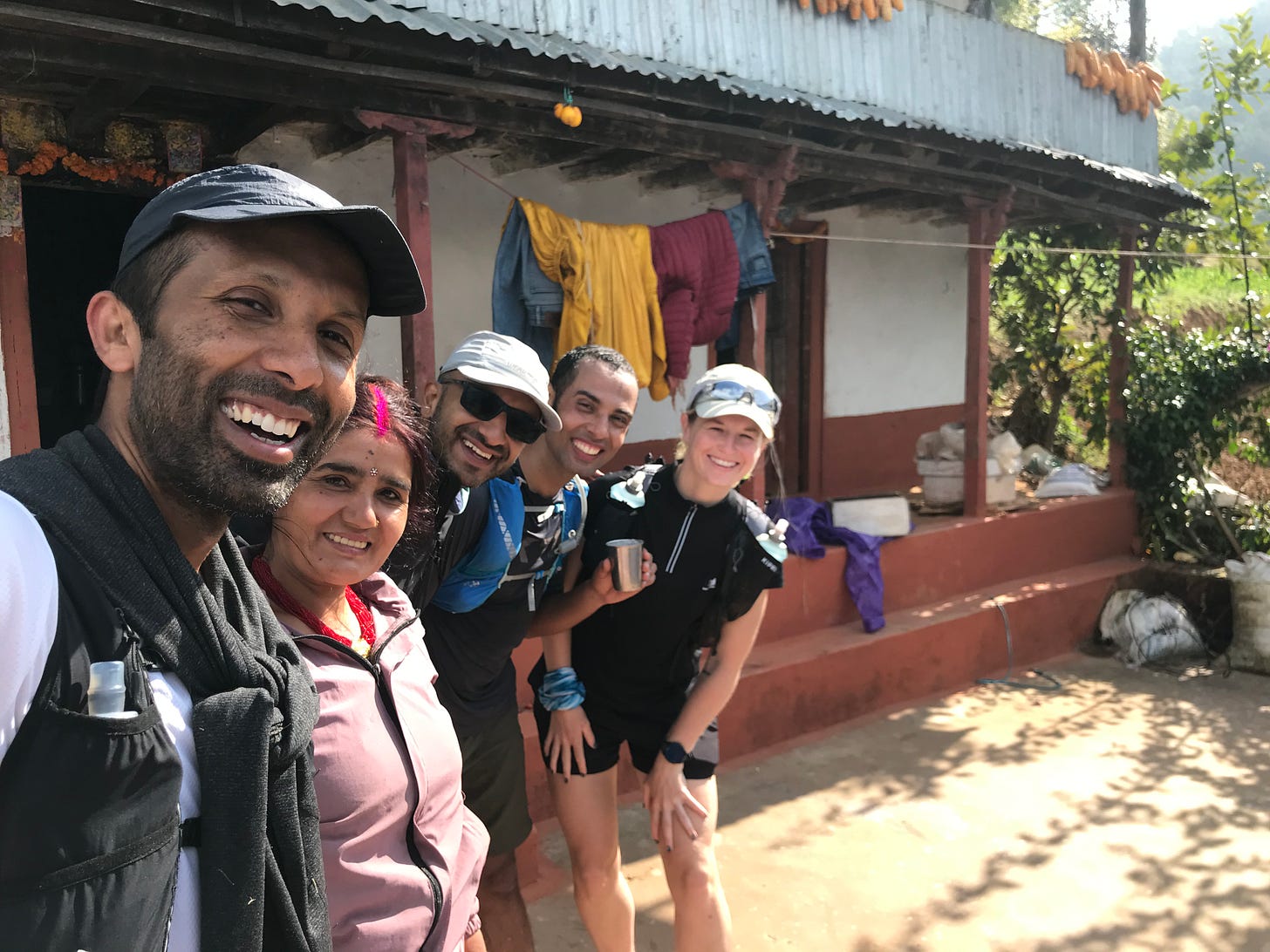
We were overwhelmed by her generosity. It seemed to radiate naturally from who she was. The encounter felt magical - one of those unexpected gifts the uncharted trail occasionally offers.
We continued towards Sankhu, passing lush paddy fields glowing in shades of luminous green. The velvety terraces curved elegantly along the hillside. I found myself mesmerised by the light filtering through the leaves, as though the fields were illuminated from within.
We briefly stopped to meet the Sankhu Ward Chairperson with whom Bishal had been in touch. He expressed genuine interest in hearing our opinions on improving tourism, drawing in visitors and promoting Southern Lalitpur. As we concluded our meeting he briefed us on the trails ahead.
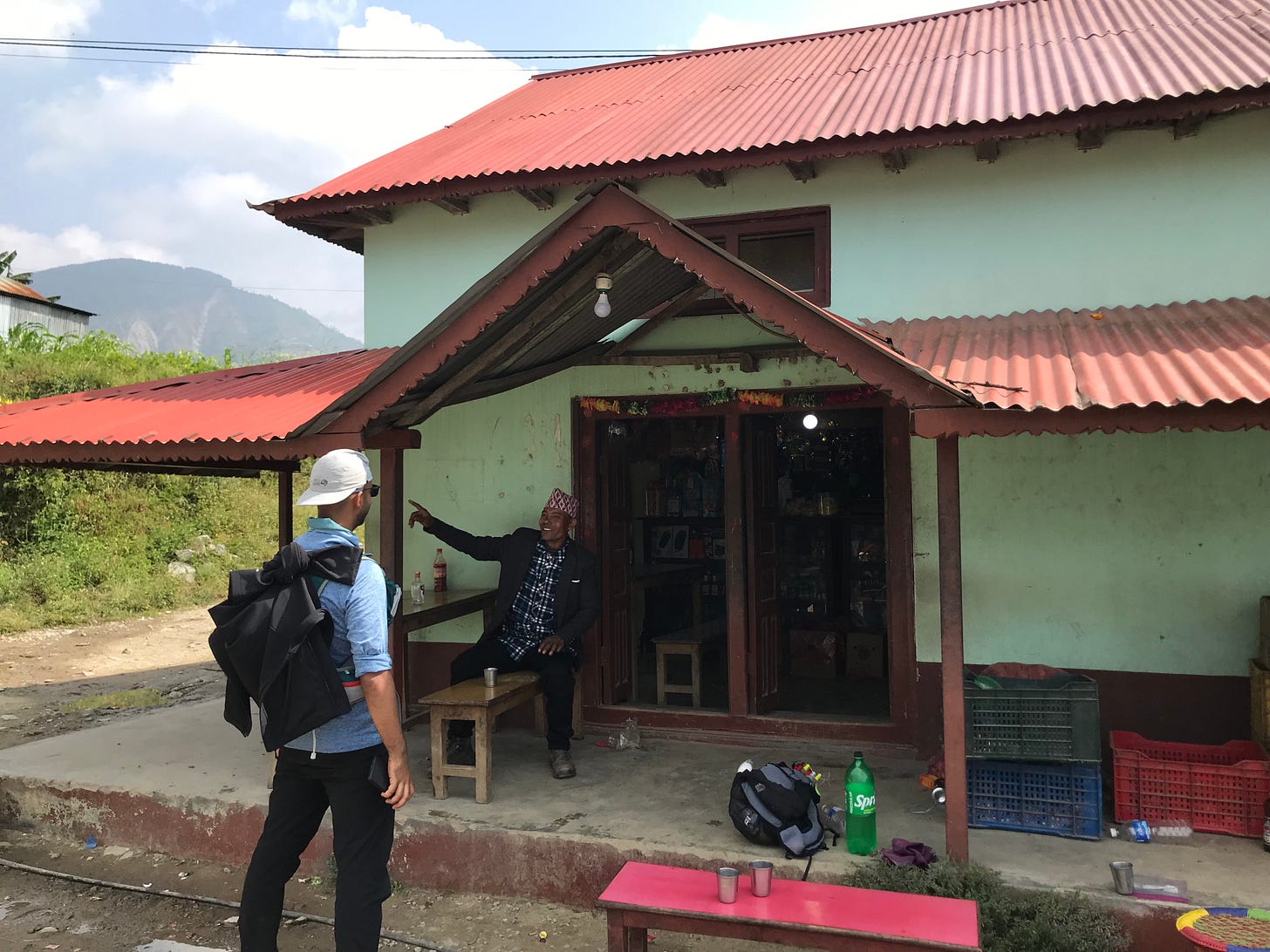
We continued running until we came across a tea shop at a crossing. We enjoyed chatting with another local who was curious about our journey. Bishal was asking about the places along the route to Gimdi. The locals seemed impressed, and perhaps a little doubtful, whether we would make it to Gimdi the very same day. They were surprised by the distance we intended to cover.
Little did we know how challenging this long trail run would turn out to be. We were heading through unknown territories of Southern Lalitpur - villages, thick forests, fields, dirt roads, ups and downs - where we would hardly encounter another traveller.
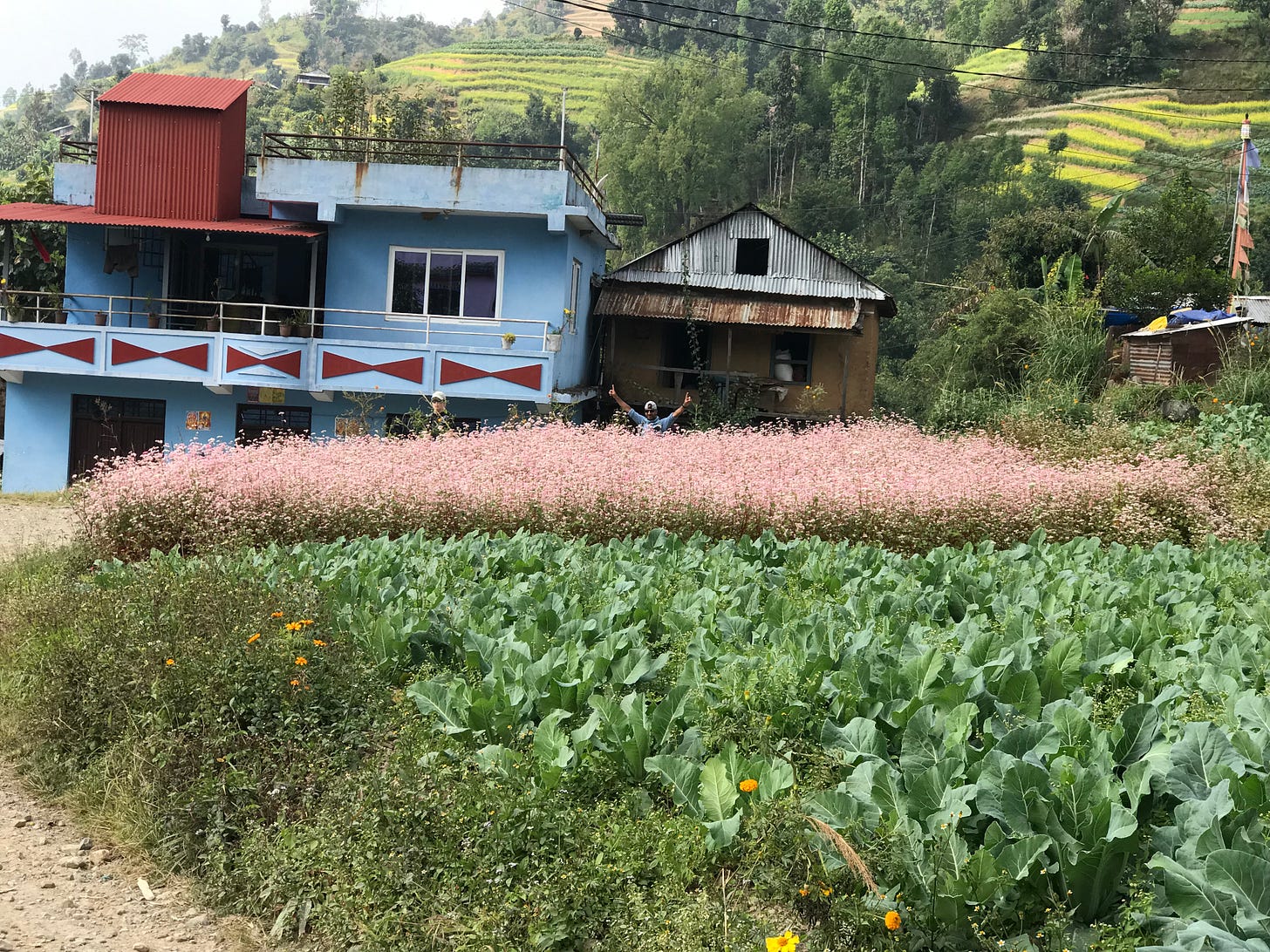
We passed through the settlements of Thakhel and Bukhel. People were going about their everyday lives. We took this turn around fields of pink buckwheat fields and cauliflowers, and saw the picturesque village of Gotikhel further down, beside a river. We stopped briefly. The quaint village settlements, fields full of produce, hills on either side, and a beautiful river making its way through the village further down. Far away on the right I couldn’t help notice a majestic hilltop. It stood tall and magical, like a far-fetched dream enveloped in mist and clouds.
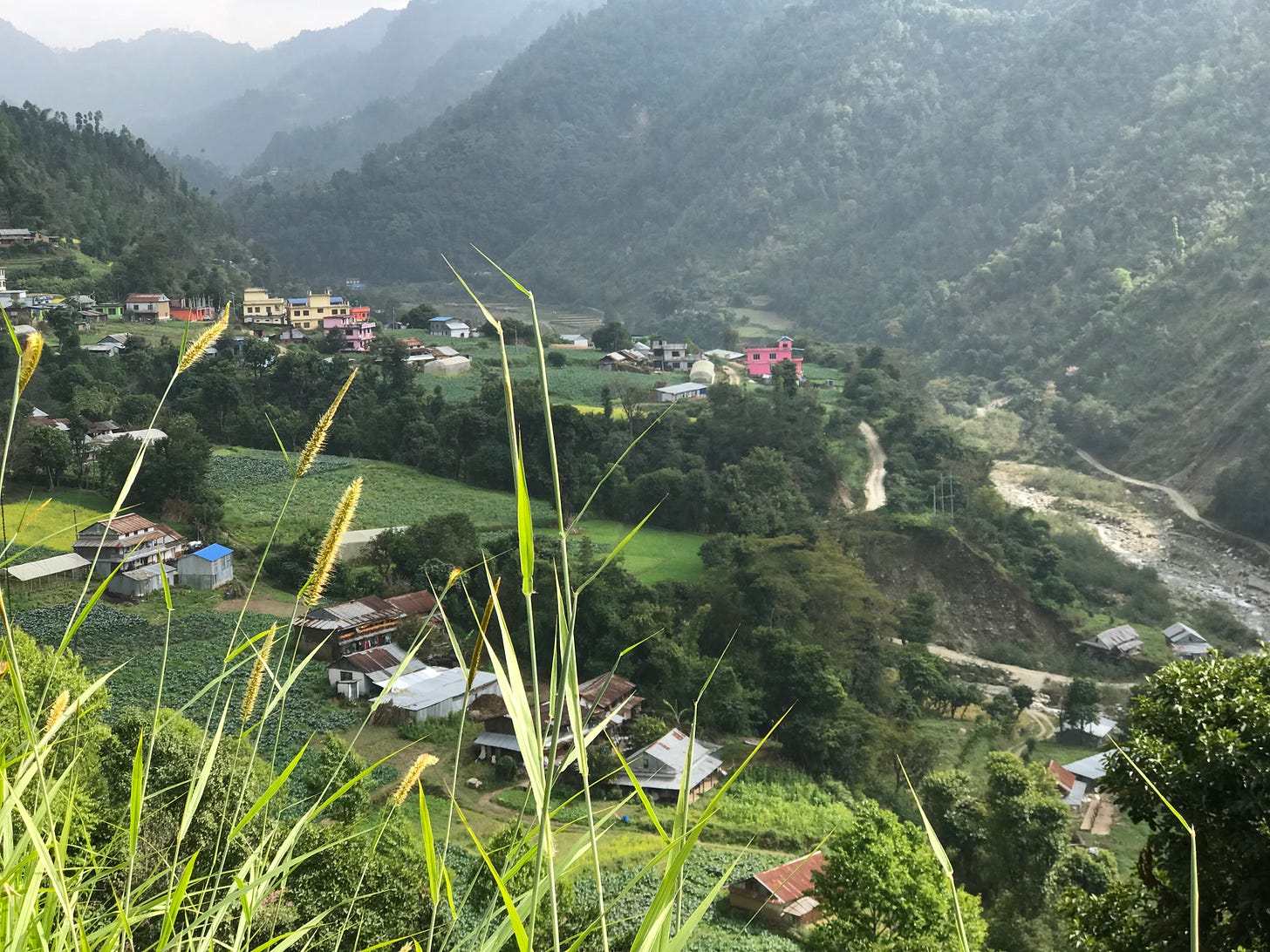
The Gotikhel Ward Chairperson was kind enough to offer us lunch. Bishal had been in touch with him while planning. The ingredients were locally sourced, and everything tasted wonderfully fresh and soft.
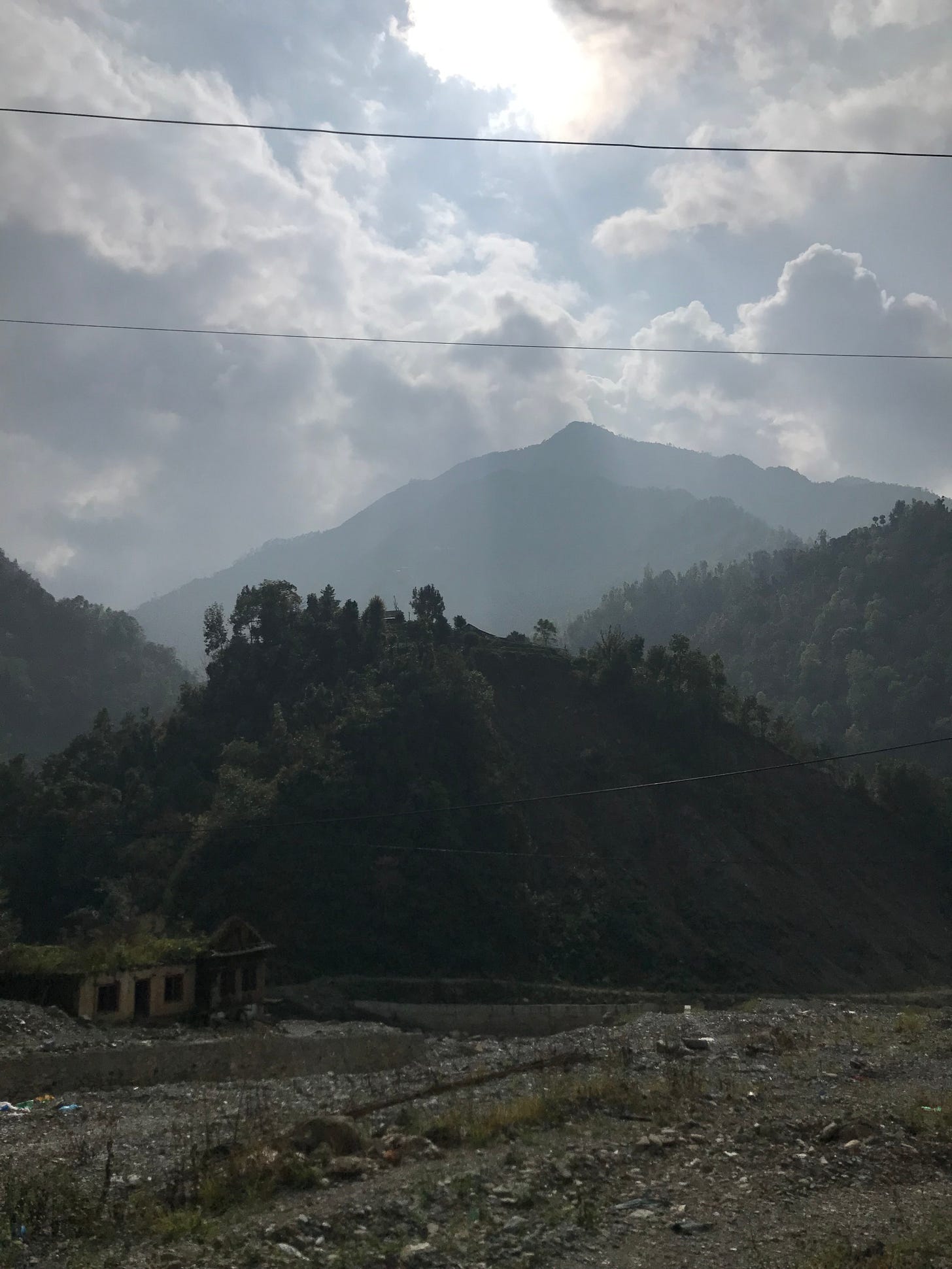
That mystical hilltop on the far right was Kaleshwor Hill. The climb was steady and exhausting. We took a few breaks along the way to enjoy the beauty. As we gained elevation it became increasingly cloudy and a little foggy.
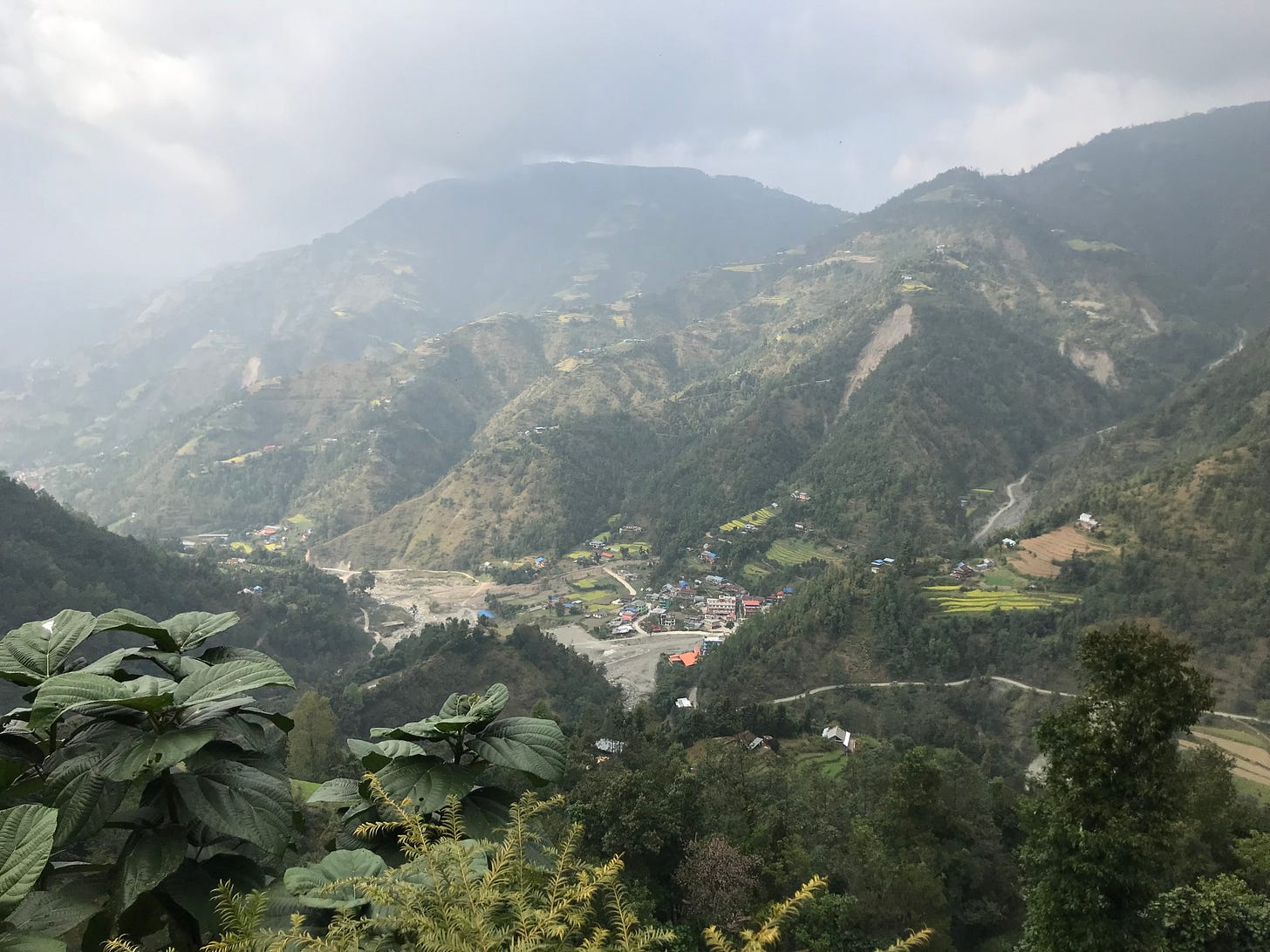
There were a few villages we passed through. We were getting thirsty and craving some tea or Chyang. At the last house in the upper settlement, we asked if we could get some milk tea. Unfortunately there was none.
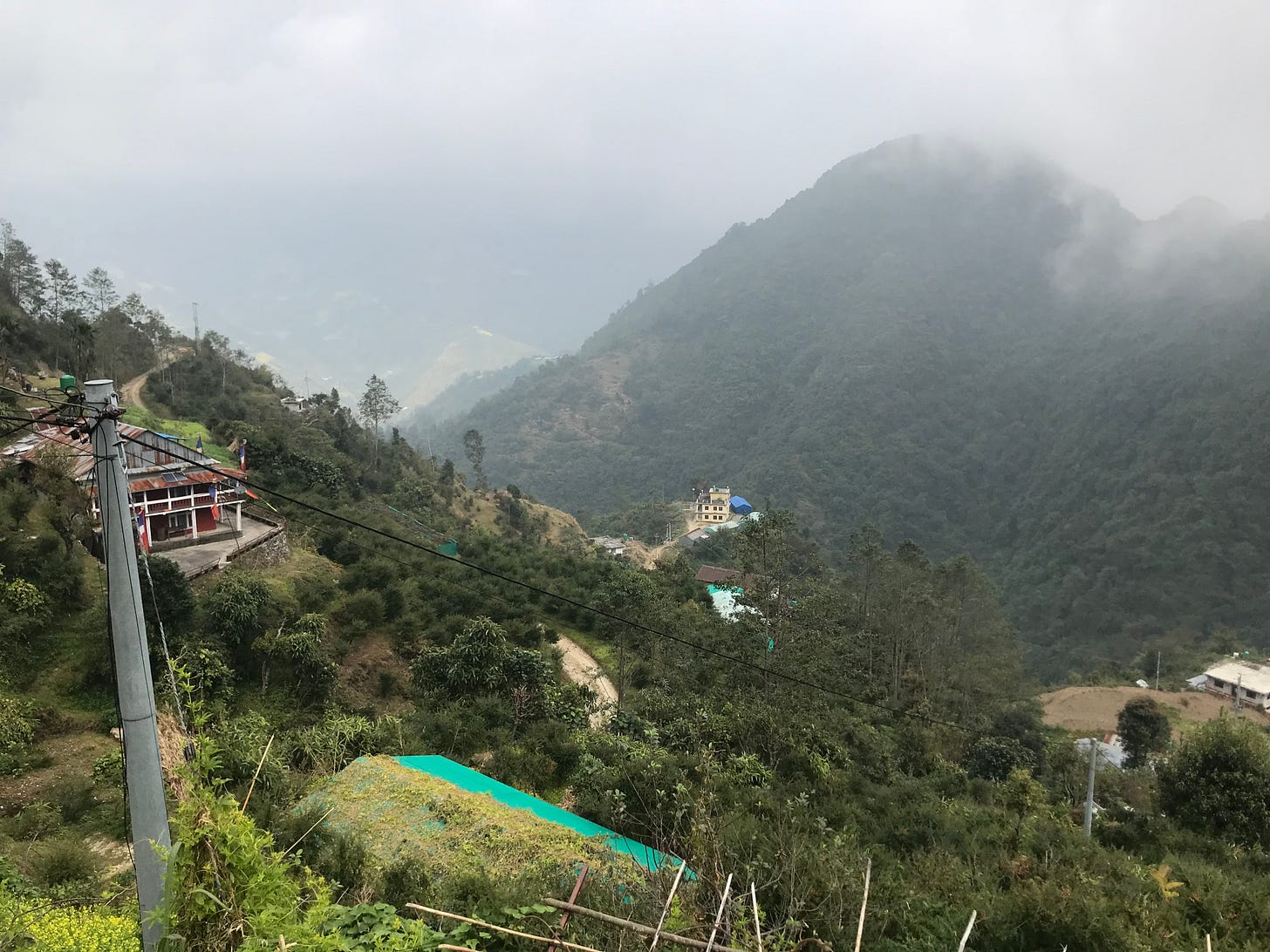
The steep climb eventually gave way to an easier, gently ascending dirt track. It first led us to a parking area, with steps further leading to the Kaleshwor Mahadev Temple on top of the hill.
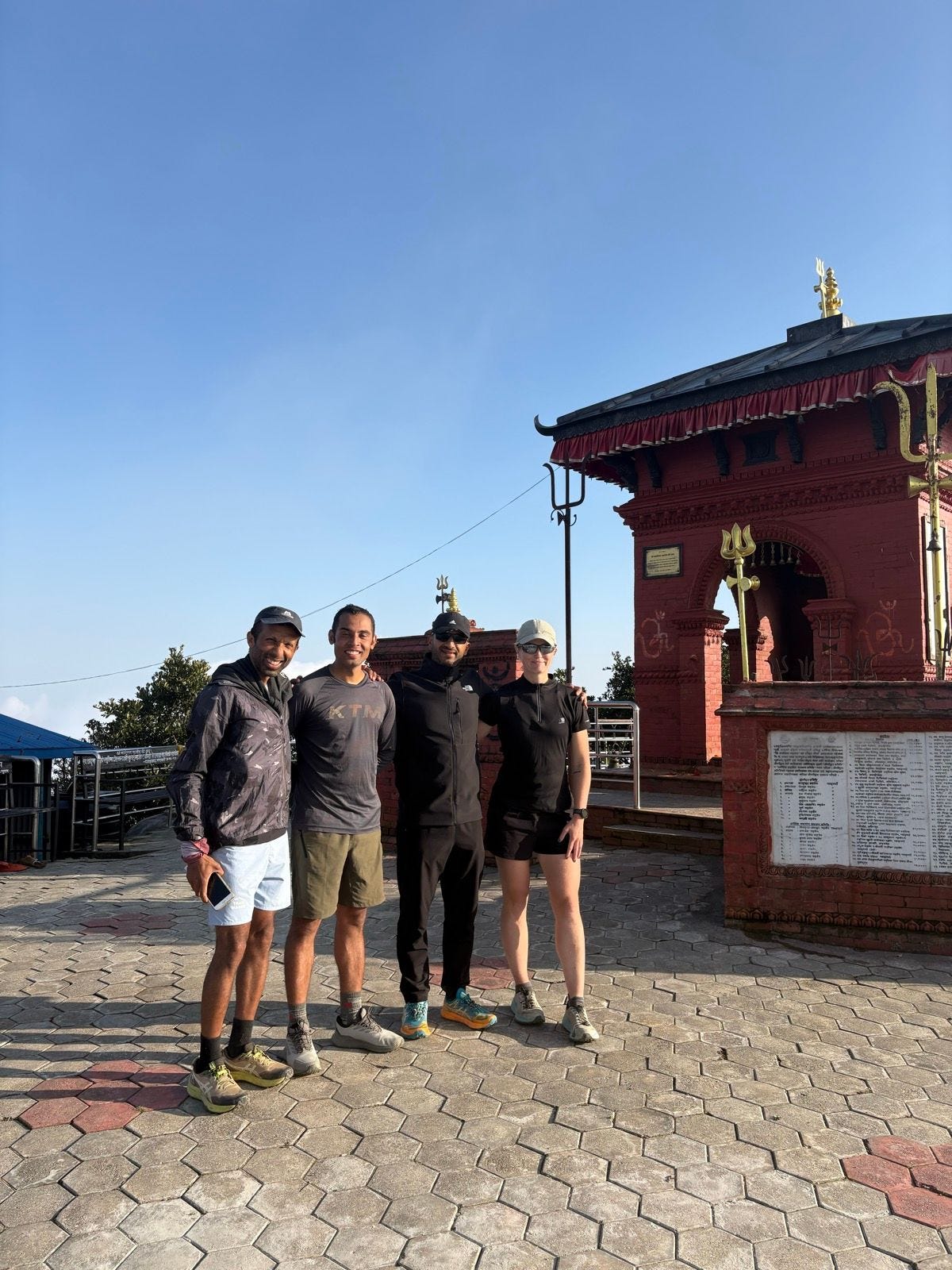
We decided to take a small break and snack on some treats we had been carrying along. We relished Mohi from the beautiful lady we had met earlier. It had churned up some butter chunks. I applied a small portion of it on the dry recovering wound on my left thigh.
We were met by an elderly gentleman living on the Kaleshwor hilltop. Bishal didn’t waste any time asking for directions and time it would take to reach Gimdi. It had taken him three to four hours to Gimdi in his younger days, he replied.
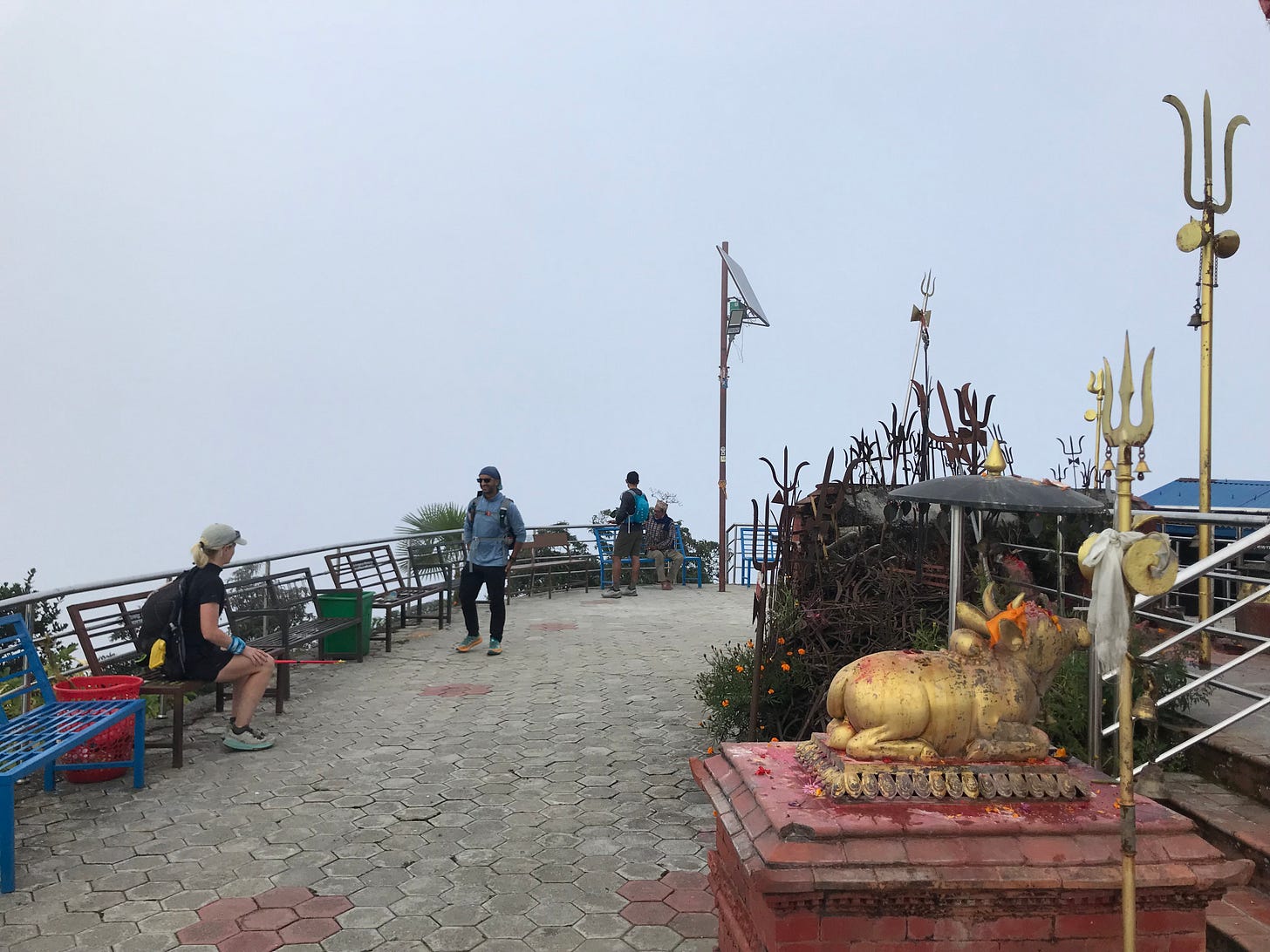
I estimated 20.30 at the earliest that we could be in Gimdi. I was also looking at the map and suggested that perhaps we could stop or stay somewhere in between, like Barkithum, so that we wouldn’t have to run through the dark in unfamiliar territory.
We went looking for the trail that started from the parking area. With Gimdi lying due south, we took a route that seemed to head in the same direction. Bishal also got in touch with Krishna Dulal Dai from Gimdi, asking him for directions. The reception up there wasn’t particularly good.
The route eventually brought us back to the stairs a little further leading to Kaleshwor hilltop. We exclaimed in unison, “Loop #1!”
We went back to the parking area and looked again. The trail passing by the dumping pit seemed to lead somewhere. As we advanced it began to feel like the right trail - the very trail we had abandoned earlier because it seemed to head in a different direction. The further we went the more certain we became that we were on the right path. It is the old trade route used to carry beans and other produce from the villages in and around Gimdi to the Kathmandu Valley.
The trail descended steeply into dense forest. Few people seemed to pass this way. The path was dry and loose, scattered with pebbles that frequently sent us sliding. Each of us slipped or fell at least once. Progress demanded patience and concentration. The forest felt ancient, as though it was quietly testing our composure and persistence. We moved carefully, yet the occasional tumble remained unavoidable.
Bishal and I were leading while Bishnu accompanied Alex. Though we were following a discerning trail the absence of houses or settlements gradually began to unsettle us. Grey fog lingered and our eyes kept searching for signs of habitation. At one point Bishal spotted what looked like a house in the distance. As we approached it transformed into a large boulder. We laughed, though perhaps a little nervously.
Eventually the forest opened into a clearing. We took a short break, looking back towards the dark woods we had traversed. Spotting electric poles we followed them until a small settlement appeared in Barkithum. There conflicting opinions greeted us. One elderly resident insisted Syal Bhanjyang was close. Another suggested otherwise. By then I was ready to stop for the night. We refilled water and continued running.
Darkness eventually settled over the hills and we switched on our headlamps. Following local instructions we searched for a single trail branching off the main track. After a while I felt we had missed it. I shared my concerns with Bishal, he calmly replied the trail eventually would lead us to some village. Pointing towards a small cluster of lights below, he assured me we would find our way. Strangely, that simple confidence eased my worry. I began enjoying the night run. We regrouped frequently, making sure no one drifted too far ahead or behind.
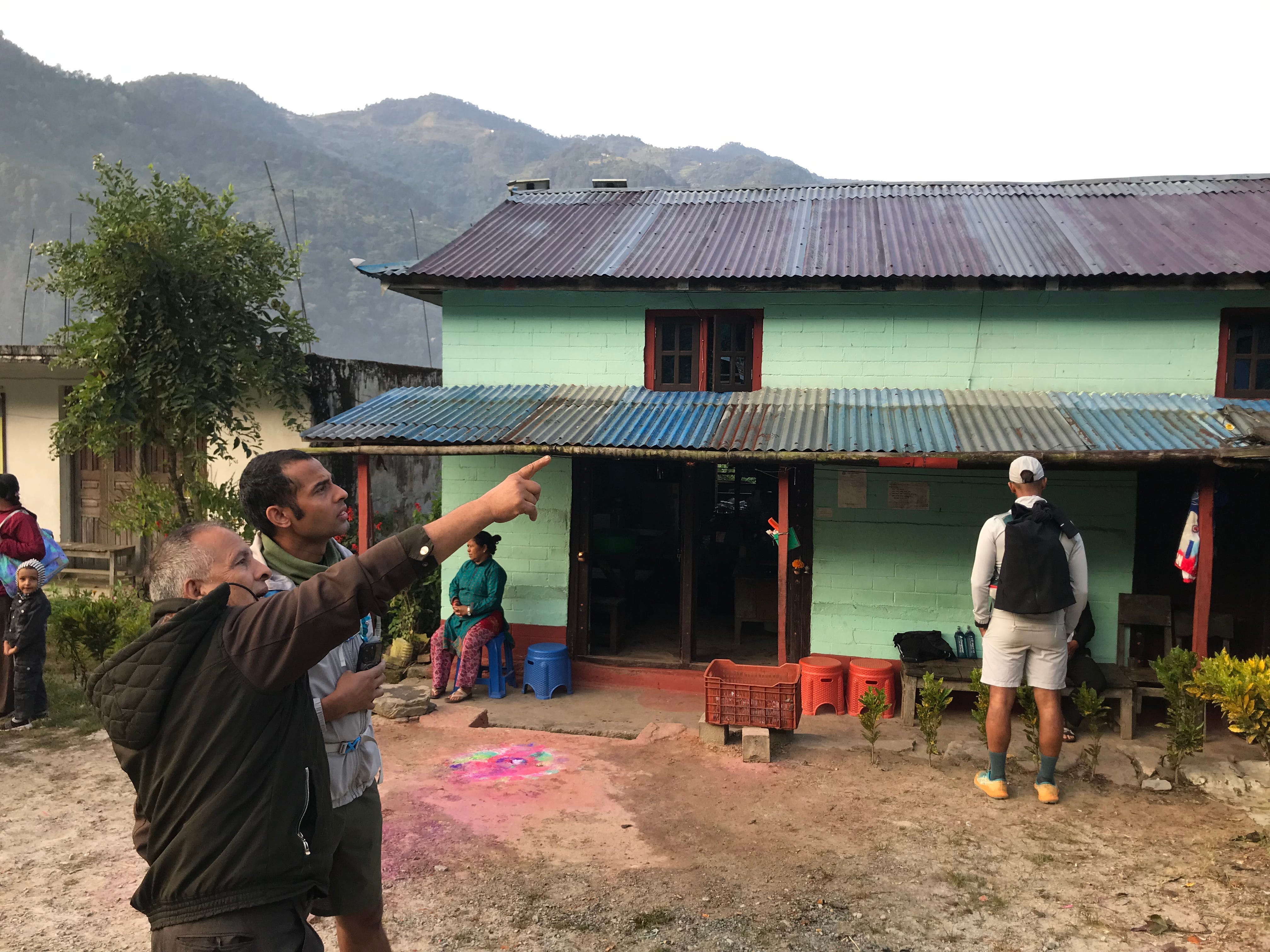
After what felt like hours of running through darkness, we finally spotted a lit house. Inside, a kitchen was bustling with activity. We stopped by to ask for some tea. We were talking to Krishna Dai over phone, and he suggested we spend the night there at Krishna Sanjel Dai’s home. I was glad we had found this refuge. We were led into a smaller kitchen where two large pans of milk simmered slowly into Khuwa. We also asked for some Khuwa. The tea, salty biscuits and fresh Khuwa tasted wonderful after the long descent. That was a really really good tea in a while. It was the warm reception and kindness at Ramesh Dai and his family that stayed with us.
Though I thought we’d stay at Ramesh Dai’s home, I agreed with Bishal that we move on. He had a good point - the trail next day would be longer to return unless we got to Gimdi. Bishal asked Krishna Dai to prepare dinner, and that we’d rather stay at his place.
We got directions from Ramesh Dai. We were descending as we ran in the dark night - guided by our light, the trail below and the directions. We again got lost after taking a wrong turn. The trail took us to steep slopes on the hill. I tried looking in the map, there was a 700 m drop before hitting a marked trail. We decided to return and continue on the path we had deviated from. As we passed by a few houses, we got confirmation we were on the right path to Gimdi and Krishna Dai’s homestay. After another series of junctions and phone calls we reached Magar Village. We briefly stopped for water refill and further directions at one of the houses. We passed the white Chortens in the village, and crossed a stream further. We were still running as we came to yet another settlement. At one house I stopped and asked about Krishna Dai’s homestay.
The man smiled. “You are already here.”
We had made it.
Not only Krishna Dai, but much of his family came out to greet us. Sitting together, we shared stories of the long journey from Dalchoki through forests, villages, ridges and forgotten trails.
Being next to Bagmati river and Makwanpur district on the other side, it felt almost surreal to realise how far we had travelled on foot. What had started as a yellow line on a map now felt like a living landscape stitched together by kindness, uncertainty, and countless footsteps.